 AI Summary


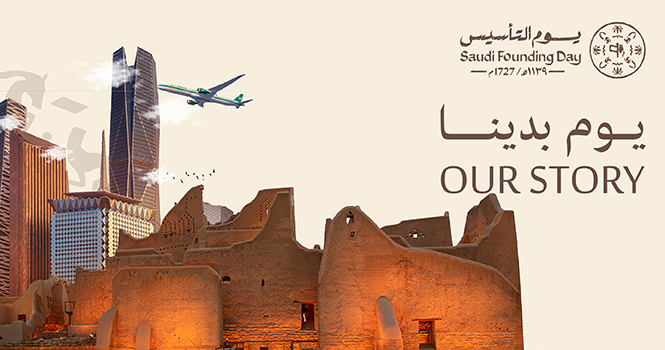
Saudi Arabia celebrates today, Feb. 22, the Founding Day—marking the anniversary of the foundation of the Saudi state.
It is a national occasion that commemorates the founding of the Saudi state by Imam Mohammed bin Saud more than three centuries ago. Saud’s leadership established a political entity that achieved unity and stability, brought people together, and laid the foundations for prosperity. Culture and science flourished, and Diriyah became the capital of the state.
Custodian of the Two Holy Mosques King Salman bin Abdulaziz said: “We take pride in the anniversary of the founding of this blessed state in 1139 AH (1727). Since that time and until today, it has laid the foundations of peace and stability and upheld justice. Our celebration of this anniversary is a celebration of a nation’s history, the unity of its people, resilience in the face of challenges, and aspirations for the future.”

Crown Prince Mohammed bin Salman said: “We have a deeply rooted significant history that stretches far back in time and connects with many civilizations. It is not true that the history of the Arabian Peninsula is linked to a very short period, as many people assume. In reality, we are a nation with ancient roots.”

Feb. 22 was designated as the founding date of the Saudi state, because it marks the beginning of Imam Mohammed bin Saud’s rule in Diriyah in the second half of 1139 AH, namely 30 Jumada Al-Akhirah 1139 AH, corresponding to Feb. 22, 1727.
Among the most notable achievements of Imam Mohammed bin Saud were unifying Diriyah under his rule and promoting stability, establishing political independence free from external influence, inviting towns to join the Saudi state, building the Al-Turaif district next to Ghasiba, organizing state resources, constructing the wall of Diriyah to defend against external attacks, strengthening internal affairs and the community of Diriyah, supporting and protecting the reform movement, confronting campaigns against the state, promoting regional stability, unifying most of Najd, and securing pilgrimage and trade routes.

Since its founding, the Saudi state witnessed significant developments across all sectors that continue through the leadership of King Salman and Crown Prince Mohammed bin Salman. Under their governance, the Kingdom is building a diversified and sustainable economy through Vision 2030, which has driven comprehensive progress across economic and social sectors.
The Crown Prince stated that Saudi Vision 2030 has entered its third phase this year. This requires intensifying implementation efforts, accelerating progress, and expanding growth opportunities to ensure a lasting impact beyond 2030 and to preserve the gains of national transformation for future generations.
The key milestones in the establishment of the Saudi state include the founding of Diriyah in 850 AH (1446), the establishment of the First Saudi State in 1139 AH (1727), the Second Saudi State in 1240 AH (1824), the founding of the Kingdom of Saudi Arabia in 1319 AH (1902), and the unification of the Kingdom in 1351 AH (1932).

Founding Day reflects the historical continuity of the Saudi state and highlights its deep civilizational roots. It also celebrates the Kingdom’s rich cultural heritage and honors the imams, kings, and citizens who contributed to serving the nation.
The Founding Day differs than the National Day. Founding Day marks the establishment of the First Saudi State by its founder, Mohammed bin Saud; while the National Day commemorates the unification of the Kingdom of Saudi Arabia by King Abdulaziz bin Abdulrahman Al Saud.

The Founding Day emblem features five core elements: the Saudi flag, the palm tree, the falcon, the Arabian horse, and the market. These symbols reflect a vibrant heritage and enduring traditions.
The palm tree is a central element of Saudi identity and culture. Its fruit has long been a staple food and source of income, while its fronds and trunks have been used to produce everyday necessities.
The Arabian horse has deep roots in the Arabian Peninsula and has long been associated with authenticity and pride. The imams of the Saudi state played a key role in preserving and improving its bloodlines.
Falconry is a well-known tradition in the Arabian Peninsula. During the First Saudi State, falcons were exchanged as gifts among leaders and rulers.
Markets flourished during the First Saudi State, and trade was a primary source of livelihood for its people.
The Saudi flag symbolizes unity, belonging, and patriotism. It is raised in battles to inspire national pride and in government institutions and official occasions.
The objectives of Founding Day include taking pride in the deep roots of the Saudi state, honoring the strong bond between citizens and their leaders, recognizing the unity, security, and stability established by the state, celebrating the resilience of the First Saudi State in defending itself, valuing the continuity and renewed strength of the Saudi state, honoring the national unity established by King Abdulaziz, and appreciating the achievements of his sons, the kings who strengthened the Kingdom’s unity and development.
Be the first to comment


Comments Analysis: