 AI Summary


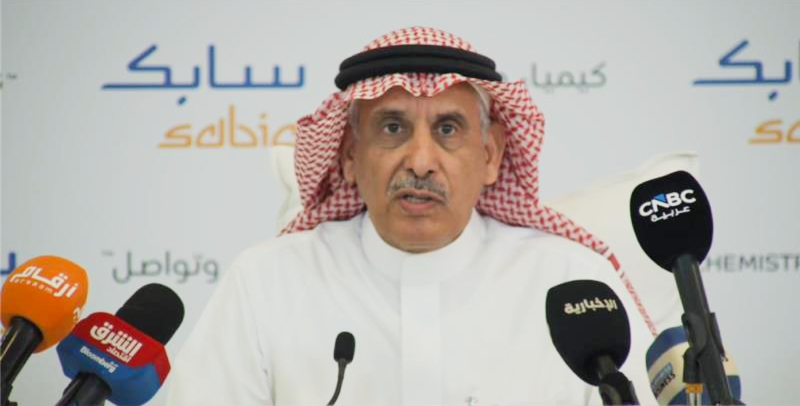
Abdulrahman Al-Fageeh, SABIC CEO
Saudi Basic Industries Corp.’s (SABIC) future performance will depend on several key factors, most notably monetary policy easing, greater geopolitical stability, and stronger global economic growth, said Abdulrahman Al-Fageeh, SABIC CEO.
Speaking at SABIC’s 2025 financial results press conference, Al-Fageeh said that demand across most segments remained stable in the recent period, with the exception of the electric vehicle segment.
He expects the electricals and electronics segments to improve in Q1 2026.
He added that the company continues—consistent with prior periods and in line with global best practices—to report adjusted financial metrics that exclude non-operating, non-recurring, and non-continuing items to provide a clearer view of operational performance.
Al-Fageeh explained that the losses recorded in 2025 were mainly due to the revaluation impact of certain assets announced for divestment, compared with a net profit of around SAR 1.5 billion in 2024.
Adjusted net profit, excluding non-operating, non-recurring, and non-continuing items, reached approximately SAR 2.1 billion.
Al-Fageeh said the results reflect SABIC’s ability to adapt to market challenges and maintain a solid financial position despite the one-off negative impact from divestment transactions.
He emphasized that the company’s resilience strengthens its capacity to navigate future challenges and continue delivering sustainable value to shareholders.
Income from operations—excluding the assets divested in 2025—shifted from a loss of about SAR 2.7 billion to a profit of roughly SAR 4.4 billion.
The EBITDA margin also improved from 10.9% to 14.1%.
Al-Fageeh noted that SABIC has not been impacted so far by regional geopolitical developments in terms of plant safety, production, or exports.
He added that the company has activated precautionary measures to manage export operations and mitigate potential risks.
Demand for the company’s products remains stable, the CEO noted, highlighting that SABIC operates production facilities across several continents in addition to its operations in Saudi Arabia.
The CEO added that higher gas or feedstock prices could be reflected in final product prices in the short term, but the company’s current priority is ensuring operational continuity and plant safety worldwide.
Meanwhile, Salah Al-Hareky, Executive Vice President for Corporate Finance, said the petrochemicals industry is undergoing structural rather than cyclical changes.
He pointed out that global capacity expansions—particularly in China—have altered supply-demand dynamics.
He added that SABIC has launched two major initiatives to address these changes: a corporate transformation program targeting $3 billion in gains by the end of 2029 and a portfolio optimization initiative that includes divesting certain assets in Europe and the Americas.
Al-Hareky said portfolio optimization is an ongoing process, noting that the company continues to review its assets periodically and may announce further updates once studies are finalized.
Regarding recent divestments, he said some of the assets sold had been generating annual cash losses ranging between $800 million and $1 billion, prompting the company to divest them to enhance profitability and reallocate capital toward higher-return investments.
He added that the recent divestments will strengthen SABIC’s financial position.
Following the restatement of 2024 financial statements, earnings before interest and taxes rose from about SAR 19 billion to SAR 21 billion, while net profit increased from around SAR 4 billion to nearly SAR 7 billion.
Al-Hareky affirmed that SABIC remains focused on maximizing shareholder value and expanding future investments in high value-added sectors to support long-term growth.
According to data available with Argaam, SABIC reported losses of SAR 25.78 billion for 2025, compared with a net profit of SAR 1.5 billion in 2024. Q4 2025 losses amounted to SAR 20.94 billion.
Be the first to comment


Comments Analysis: