

-
 Bank Ranking
Banks Ratios
Cement Statistics
Cement Ranking
Cement Ratios
Monetary and Economic Statistics
Oil, Gas and Fuel
Macro Economy
Consumer Spending
Inflation
Exports & Imports
Food Prices
Non Food Prices
Construction Materials
Petrochem. Ranking
Petrochem. Ratios
Retail Rankings
Retail Ratios
Grocery Ranking
Grocery Ratios
Top Growth
Dividend History
Bank Ranking
Banks Ratios
Cement Statistics
Cement Ranking
Cement Ratios
Monetary and Economic Statistics
Oil, Gas and Fuel
Macro Economy
Consumer Spending
Inflation
Exports & Imports
Food Prices
Non Food Prices
Construction Materials
Petrochem. Ranking
Petrochem. Ratios
Retail Rankings
Retail Ratios
Grocery Ranking
Grocery Ratios
Top Growth
Dividend History

When Does Saudi Arabia's ETF Market Stand on Its Own?

 AI Summary

Content Summary: 

In February 2026, Saudi Arabia made two moves in four days. On February 1, the CMA abolished the Qualified Foreign Investor regime, removing the asset thresholds that had long restricted foreign access to Tadawul. On February 5, the Saudi Exchange announced an ETF Market Making Framework offering licensed brokerage firms and investment banks a full daily fee waiver across Saudi Exchange, Edaa, Muqassa, and CMA commissions — conditional on meeting defined obligations on spreads, order size, and quoting time.
Both measures are designed to make Saudi Arabia's ETF market impossible to ignore. But they are not the same kind of policy.
The QFI abolition is a structural reform. It removes a gate permanently. Its effects accumulate without further funding.
The fee waiver is a subsidy. An incentive changes what a participant wants to do — permanently altering their commercial calculus. A subsidy changes what they can afford to do, for as long as the payment continues.
Saudi Arabia is supporting market makers to show up. The question is whether it will always have to.
Market makers earn from volume. Saudi Arabia's ETF market does not yet generate enough of it to make continuous quoting commercially viable without support. The fee waiver covers that gap — which is the definition of a subsidy, not an incentive. Subsidies do not compound; they persist. Remove the waiver before organic liquidity develops and market makers reprice, spreads widen, and the market stalls.
The QFI abolition expands who can invest. It does not resolve why they would. Foreign institutional capital follows liquidity, not eligibility. What Saudi Arabia has not stated is when — and under what conditions — it expects the support to become unnecessary.
The Fee Waiver Has a Break-Even
On Tadawul, the ETF Market Making Framework sets maximum permitted spreads by tier: 0.65% for Tier A, 1.00% for Tier B, and 2.00% for Tier C. These spreads define the market maker's gross revenue per trade — the difference between what they buy at and what they sell at.
The problem is that spread revenue is only meaningful at volume. In a thin market, the total earnings generated by those spreads fall short of what it costs to run the operation — the technology infrastructure, risk capital, compliance, and staffing that continuous quoting requires. The fee waiver fills that gap.
This also defines, precisely, the exit condition Saudi Arabia has not articulated: the point at which natural trading volume drives spread revenues above the fixed cost floor. At that point, the subsidy becomes redundant. The market maker stays because the market pays.
How Far Tadawul's ETF Market Has to Go
Benchmark data from India's NSE and South Africa's JSE suggests that a market maker operating in a frontier ETF market typically requires annual revenues of SAR 1.5–2.5 million per fund to cover its costs — varying by tier obligation.
Running that against Tadawul's Tier B spread maximum and the typical daily turnover ratio for emerging market ETFs — which runs between 0.04% and 0.06% of assets under management — produces a specific threshold: a single ETF needs to reach SAR 1.5–3.0 billion in AUM before a market maker can sustain its presence without external support.
As of May 2026, Tadawul currently has 13 ETFs actively trading, with total market AUM of approximately $2 billion — roughly SAR 7.5 billion. Average fund AUM is well below the self-sustaining threshold.
The full market requires total ETF AUM of approximately SAR 20–40 billion before the ecosystem does become commercially self-sustaining across its listed product range — a three- to five-fold increase from today.
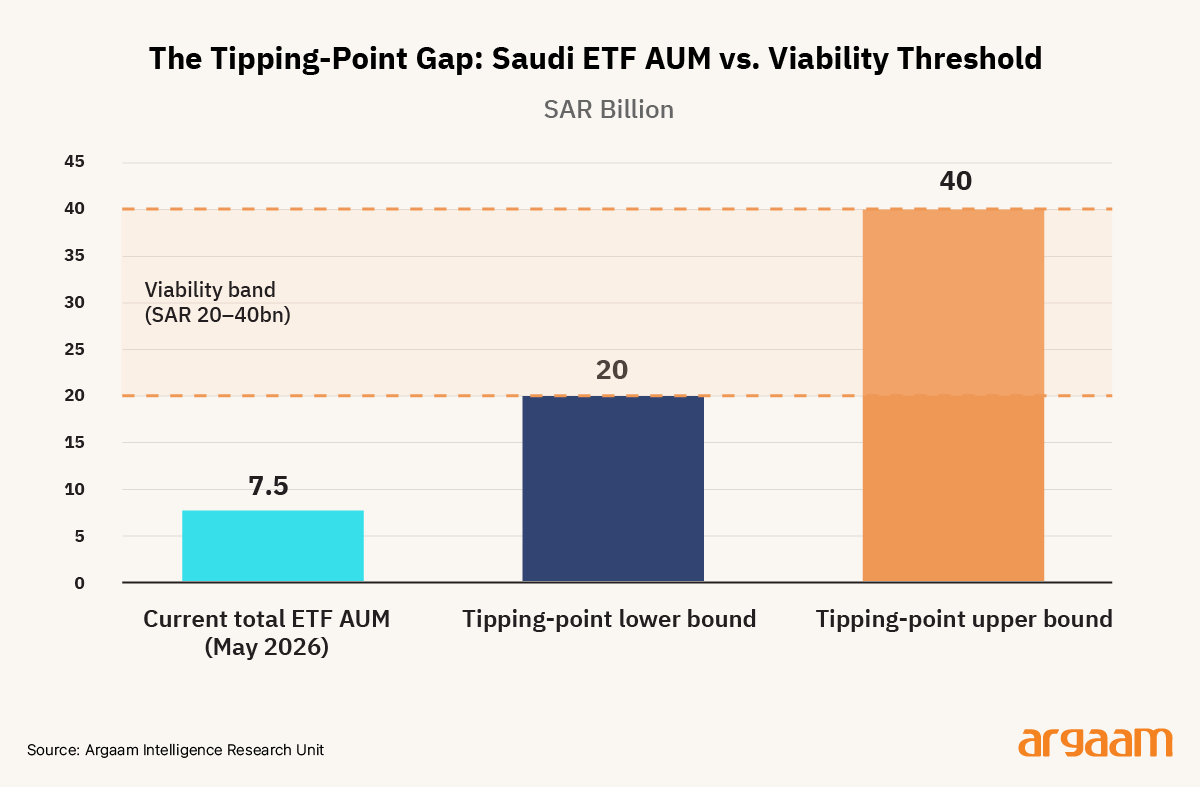
The market grew from $410 million in 2022 to over $2 billion by mid-2025, a fivefold increase that reflects genuine momentum. The absolute size, however, remains modest against the SAR 20–40 billion threshold at which the ecosystem becomes commercially self-sustaining.
The growth rate is encouraging. The gap is not small.
Until trading volumes generate enough spread revenue to cover market makers' fixed costs without assistance, the fee waiver is not a policy choice Saudi Arabia can revisit. It is a structural requirement.
What Happens If That Level Is Never Reached?
The failure scenario here is not a tail risk. Most emerging market ETF programmes that launched without a sufficient AUM base followed the same trajectory — and Tadawul is not yet above that threshold.
Three risks compound over time if it does not get there.
The first is fiscal. The fee waiver remits 100% of exchange, clearing, and regulatory commissions on every ETF trade. As the product range expands and more funds are listed, the total annual cost to the state grows in direct proportion. There is no natural ceiling on that liability until the market reaches scale.
The second is structural dependency. Once market makers have been compensated for operating in a thin market, withdrawing the support without a credible AUM base in place triggers an immediate liquidity cliff. Spreads widen, volumes fall, and foreign investors — whose participation depends on reliable liquidity — exit. The programme risks becoming a permanent floor rather than a temporary bridge.
The subsidy that was designed to build the market begins, instead, to substitute for it.
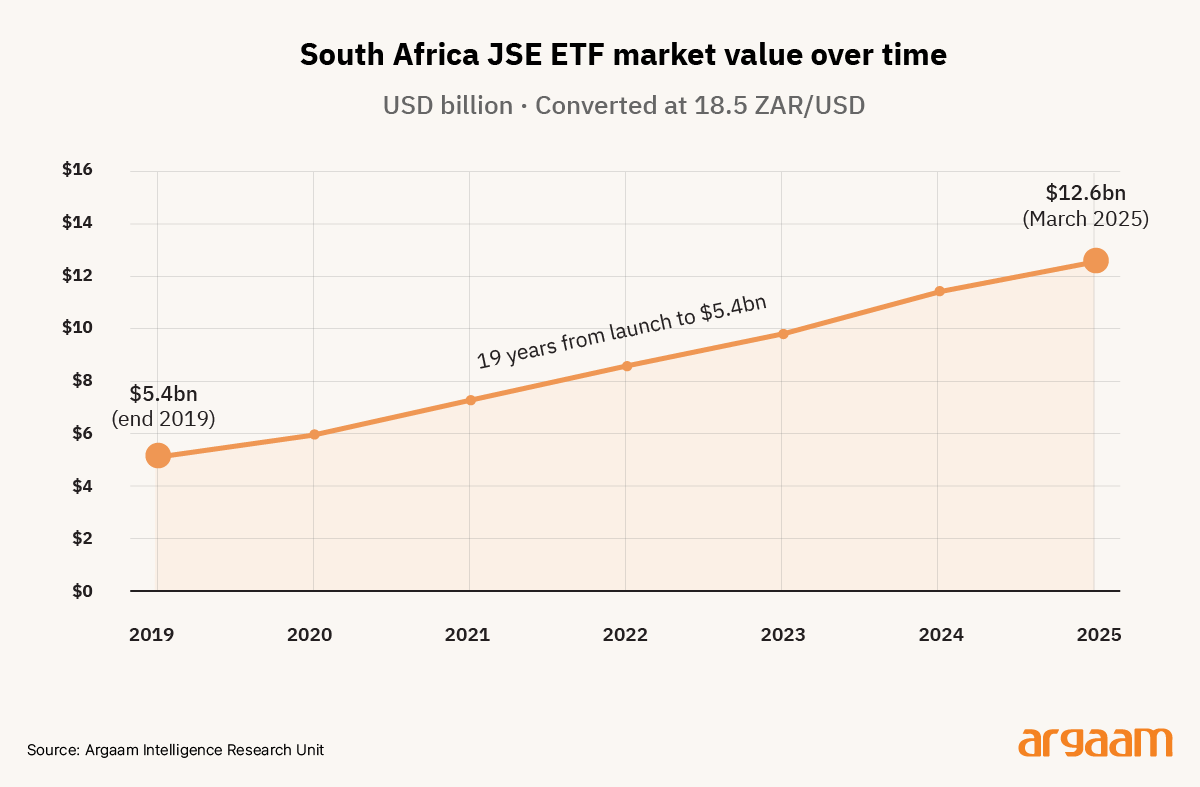
The JSE's experience is worth examining carefully. South Africa's exchange listed its first ETF in November 2000 with the regulatory framework in place and market makers present. The JSE is Africa's most sophisticated exchange. Yet total ETF market capitalisation did not cross R100 billion ($5.4 billion) until late 2019 — nearly two decades after launch. By the first quarter of 2025 it had reached R233.6 billion ($12.6 billion).
The slow early growth was not a regulatory failure. The rules were sound. What was missing was a structural AUM anchor — a large domestic institutional investor whose mandated, recurring allocations provided the baseline trading volume that makes market-making commercially viable without public support. Once that anchor existed, the market compounded. Before it did, the rules alone were not enough to make it move.
For Tadawul, the implication is direct. The CMA has reformed the access framework. The Saudi Exchange has put a market-making structure in place. But a framework is not a foundation. The question is whether Saudi Arabia has — or is building — the institutional demand base that the JSE took two decades to develop organically.
Has This Worked Before? The India’s Lesson
India is the most instructive comparison — not because it is the most prominent emerging market, but because it ran the exact same experiment as Saudi Arabia and produced both the cautionary tale and the success story within a single market history.
India's first ETF, Nifty BeES, launched in December 2001. The Securities and Exchange Board of India mandated market makers for listed ETFs and progressively opened the market to foreign portfolio investors. The regulatory architecture was, in intent, identical to what Saudi Arabia has built today.
Then nothing happened for thirteen years.
From 2002 to 2015, India's ETF market went essentially nowhere. Total AUM stood at approximately Rs 7,032 crore — roughly $900 million — as of August 2015. Market makers were present because the rules required them to be. Trading volumes were thin. Retail participation was negligible. Institutional allocations to ETFs were discretionary and small.
The market had the architecture of a functioning ecosystem. It did not have the economic activity to make that architecture mean anything. The rules were in place. The participants were present. What was absent was the one thing neither regulation nor a fee waiver can manufacture: a large, recurring, institutionally mandated source of demand that gives market makers a reason to be there that the subsidy does not have to provide.
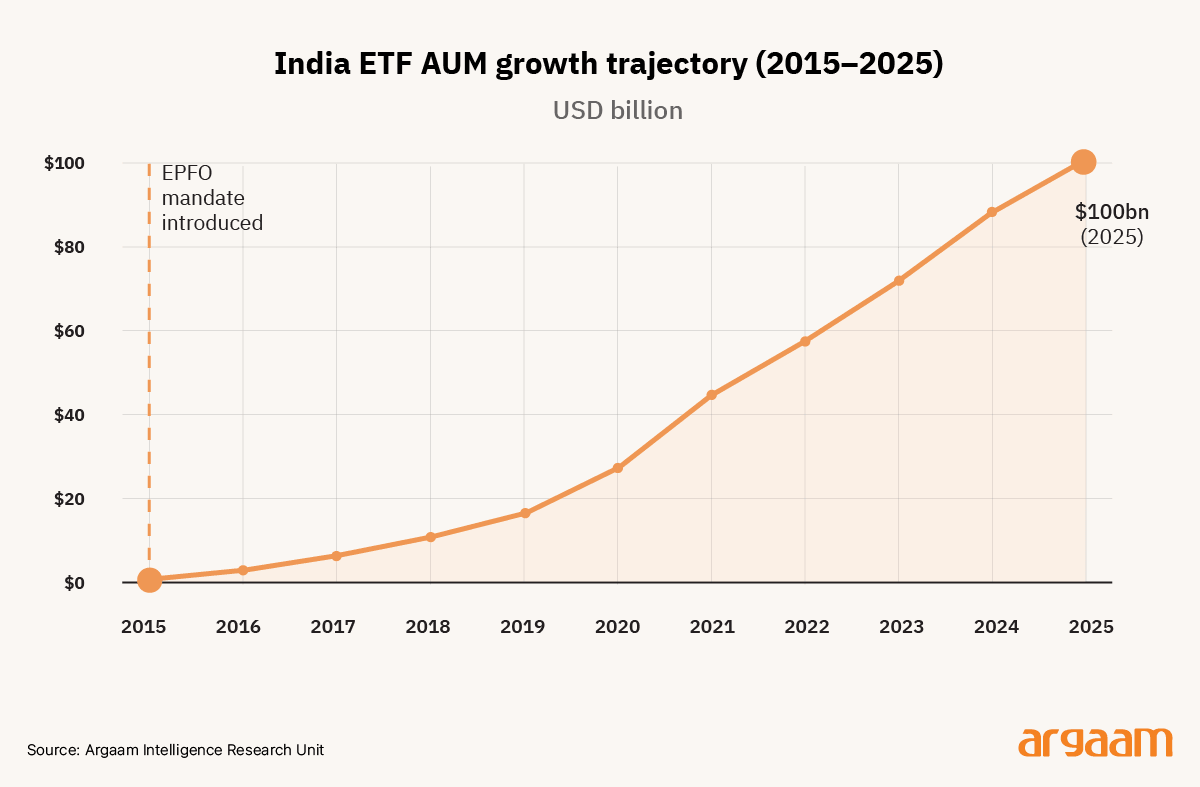
Importantly, the inflection came on August 6, 2015, when EPFO — India's state-managed retirement savings body — began investing 5% of its annual incremental corpus in ETFs, as per a government-mandated investment pattern approved April 23, 2015.
In the first financial year of investment (2015-16, August 2015 to March 2016), EPFO invested Rs 14,983 crore (approximately USD 2.3 billion). By 2022-23, annual investment had reached Rs 53,081 crore (i.e. approximately USD 6.5 billion), and cumulative EPFO ETF investment had crossed INR 2.5 trillion (approximately USD 30 billion). The effect was transformative. Between August 2015 and August 2020, total ETF AUM grew from Rs 7,032 crores (approximately USD 900 million) to Rs 2.07 lakh crores (approximately $28 billion)— a 97% annualised growth rate over five years.
By March 2025, ETF AUM had grown 5.5 times from the March 2020 base to Rs 8.38 lakh crore (approximately USD 100 billion) — approximately 13% of India's total mutual fund industry.
What broke India's liquidity trap was not a rule change or a fee waiver. It was a mandatory, large-scale, recurring institutional buyer - The EPFO was India's structural anchor. Saudi Arabia's equivalent does exist: the Public Pension Agency (PPA) and the General Organisation for Social Insurance (GOSI) together manage assets comparable, in relative terms, to EPFO's role in India's capital market. A mandated allocation of even 3–5% of their incremental annual flows into Tadawul-listed ETFs would provide the structural demand signal that the fee waiver alone cannot manufacture.
The Dimension That Doesn't Get Discussed Enough
There is a second-order argument for Saudi Arabia's February 2026 moves that is more powerful than the first-order liquidity argument — and it doesn't appear in the CMA's announcement language.
It’s the MSCI and FTSE index inclusion dynamic, and it may be what makes the subsidy self-terminating if Saudi Arabia does executes well.
Saudi Arabia entered the MSCI Emerging Markets Index in May–August 2019 at approximately 1.4% weight. By April 2025, that weight had risen to more than 4%. Around $16.5 trillion of assets are benchmarked to MSCI indices globally. Every percentage point increase in Saudi Arabia's EM weight triggers automatic passive inflows from funds tracking that index — inflows that are mechanical, large, and directly correlated with the depth, liquidity, and foreign accessibility of Saudi Arabia's market.
Following the QFI abolition and the ETF market-making framework, lendable Tadawul inventory in Saudi Arabia rose around 190% y/y in early 2025, and cumulative GCC foreign equity inflows reached around $60 billion by end of 2024. These are the structural liquidity signals that MSCI and FTSE do monitor when reviewing index weight decisions.
Greater ETF liquidity, tighter spreads, and broader foreign participation create conditions for further index weight upgrades, which do trigger further passive inflows, which deepen ETF liquidity, and which attracts more market makers — without subsidy.
The fee waiver is the catalyst, and not the engine. If the index inclusion loop operates as intended, it creates the AUM growth that makes the subsidy unnecessary. The Public Investment Fund's $200 million anchor commitment to Europe's first Saudi sovereign bond ETF in January 2025 is an early and deliberate signal that this logic is being applied. The question is whether domestic institutional architecture — PPA, GOSI, and sovereign wealth mandates — is deployed systematically enough to reach the self-sustaining threshold before the patience with the subsidy does run out.
Comments {{getCommentCount()}}
Be the first to comment
رد{{comment.DisplayName}} على {{getCommenterName(comment.ParentThreadID)}}
{{comment.DisplayName}}

{{comment.ElapsedTime}}


Comments Analysis: