

-
 Bank Ranking
Banks Ratios
Cement Statistics
Cement Ranking
Cement Ratios
Monetary and Economic Statistics
Oil, Gas and Fuel
Macro Economy
Consumer Spending
Inflation
Exports & Imports
Food Prices
Non Food Prices
Construction Materials
Petrochem. Ranking
Petrochem. Ratios
Retail Rankings
Retail Ratios
Grocery Ranking
Grocery Ratios
Top Growth
Dividend History
Bank Ranking
Banks Ratios
Cement Statistics
Cement Ranking
Cement Ratios
Monetary and Economic Statistics
Oil, Gas and Fuel
Macro Economy
Consumer Spending
Inflation
Exports & Imports
Food Prices
Non Food Prices
Construction Materials
Petrochem. Ranking
Petrochem. Ratios
Retail Rankings
Retail Ratios
Grocery Ranking
Grocery Ratios
Top Growth
Dividend History

Oil supplies to return gradually after US-Iran peace deal, prices under pressure: Analysts

 AI Summary

Content Summary: 
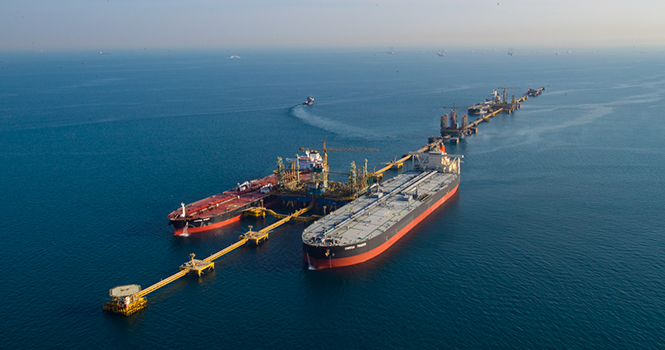
Global energy markets have begun repricing the consequences of the war after the US and Iran signed a memorandum of understanding aimed at ending the war, extending the ceasefire for 60 days, and opening a negotiation track to reach a final agreement.
The war, which broke out on February 28, quickly turned from a military confrontation into an economic crisis that was reflected in energy, shipping, and insurance markets, amid growing fears of supply disruptions through the Strait of Hormuz and a rise in the geopolitical risk premium in oil prices.
The memorandum includes the gradual reopening of the Strait of Hormuz to commercial navigation, lifting or easing restrictions related to Iranian oil exports, unfreezing some assets, and continuing negotiations on outstanding issues, mainly the nuclear file and sanctions.
Oil Declines as Risk Premium Recedes
The peace agreement was quickly reflected in oil markets, as Brent crude fell to about $77.41 per barrel, its lowest level in three and a half months, while West Texas Intermediate crude dropped to about $74.43 per barrel, as the market's focus shifted from risks of supply shortages and navigation disruptions through Hormuz to the possibility of the return of Iranian oil and increased supplies.
In this context, Nader Itayim, Gulf and Middle East Markets Editor at Argus Media, said that the decline in prices during the past week was driven mainly by expectations of increased supply, with anticipation of the signing of the memorandum of understanding between the US and Iran.

Nader Itayim, Gulf and Middle East Markets Editor at Argus Media
Markets appear overly optimistic regarding the impact of the agreement and may have exaggerated the size of the impact and the speed of oil supplies returning to their normal levels, he added.
The analyst also pointed out that oil prices could witness a limited rebound or relative stability during the days following the signing of the agreement, until the actual impact of the deal on oil flows from the region becomes clear.
“The increase in supplies will not necessarily be immediate, despite the presence of quantities of oil in the GCC region that need to exit through the Strait of Hormuz,” said the analyst, “This process may take place quickly if conditions return to normal, but logistical bottlenecks still need to be overcome before flows return to their usual levels.”
For his part, Navin Das, Senior Crude Oil Analyst at Kpler, said that the fall in oil prices following the agreement reflects a limited decline in the geopolitical risk premium across the price curve, in addition to the market’s assumption of the return of flows through the Strait of Hormuz, which puts pressure on spot prices.

Navin Das, Senior Crude Oil Analyst at Kpler
The back end of the price curve has begun to partially reflect the possibility of easing sanctions on Iran, Das said, noting that this factor has not yet been fully priced in, and that confirmation of sanctions relief could lead to further downward pressure on prices.
Initial Signs of the Return of Shipping Through Hormuz
According to vessel-tracking data cited by Bloomberg, some oil and gas tankers have begun passing through the Strait of Hormuz, in an initial indication of the shipping sector’s response to the interim agreement between Washington and Tehran. Three loaded Saudi oil tankers belonging to Bahri resumed transmitting signals in the Gulf of Oman on Thursday after having remained stranded inside the Gulf since the beginning of the war.
Bloomberg added that a vessel carrying a Qatari LNG cargo and a Chinese fuel tanker also exited the region, reflecting the beginning of a gradual return of shipping traffic through the strait, while the restoration of normal flows remains dependent on the stability of security, navigation, and insurance arrangements.
“The increased supplies will not necessarily be immediate, despite the existence of quantities of oil in the Gulf region that need to leave through the Strait of Hormuz. This process may take place quickly if conditions return to normal, but logistical bottlenecks still need to be overcome before flows return to their customary levels,” Itayim stated.
Iranian Exports.. A Rapid Return of Inventories and a Gradual Increase in Production
Itayim said that Iranian oil exports recorded a sharp decline during the past month and a half to two months, ruling out that their return would take a long time, given that Iran possesses large quantities of oil and high inventories within the country, in addition to quantities stored offshore aboard tankers that can be pumped into the market relatively quickly.
He indicated that these stored quantities may provide Iran with a temporary margin that allows it to increase exports while it works on raising production from some fields whose output had been reduced during the past period.
Itayim also pointed out that the latest Argus estimates place Iran’s current oil production at between 2.4 and 2.5 million barrels per day, about 700,000 to 800,000 bpd below production levels before the beginning of the war.
The return of Iranian production to pre-war levels does not represent a huge increase in production terms, but it will require some time. Countries in the region, including Iran, had an opportunity to plan production-cut operations, and therefore likely reduced output from fields that are easier to restart while avoiding higher-risk or more complex fields in order to preserve their long-term production capacity, he said.
For his part, Das said that the return of Iranian exports would most likely initially be directed toward China as the main buyer, even if sanctions are fully lifted, given the need for other countries to rebuild credit lines, banking infrastructure, and arrangements related to shipping, insurance, and logistics services necessary for dealing with Iran.
He highlighted that with the Strait of Hormuz remaining open and sanctions lifted, Iranian exports could return to pre-war levels within a few weeks, while volumes could approach two million bpd after the 60-day period specified in the agreement, with additional buyers entering the market.
Das also confirmed that any large and sustainable increase in exports will remain tied to Iran’s ability to raise its oil production, which requires additional investments, noting that the return of Iranian oil free from sanctions remains dependent on the stability of the agreement and the sustainability of sanctions relief.
The Risk Premium Will Not Disappear Completely
Regarding the Strait of Hormuz, Das said that the market will continue to retain part of the risk premium due to ongoing risks in the region, in addition to the possibility of isolated attacks on ships should tensions return. He noted that some flows will continue to use alternative routes through pipelines at maximum capacity to reduce dependence on Hormuz.
He expected flows through the strait to return to at least 80% of their normal levels if the memorandum is implemented, while a relative risk premium remains in prices after the developments witnessed by the region in recent months.
Similarly, Itayim said that the market will keep a risk premium in prices because the agreement does not represent a comprehensive peace agreement on which the market can fully rely, but rather a temporary agreement theoretically aimed at reducing fighting and opening a window for talks.
He pointed out that the continuing lack of trust between the US and Iran, in addition to the existence of complex issues requiring discussion during the 60-day period, means that risks to the agreement remain, suggesting that resolving these issues may take longer than the specified deadline.
The possibility of renewed tensions in the region will remain during this period, which could return the market to a state of elevated risk, even if matters do not reach the level of a full-scale war, according to Itayim.
The effects of the agreement are not limited to oil alone; they extend to the LNG market as well, especially with expectations of the return of Qatari exports through the Strait of Hormuz. Reports stated that QatarEnergy is targeting the restoration of production to about 50% of operating capacity within one month and to 80% within two months after the resumption of safe passage through the strait.
OPEC+ Monitoring Without Immediate Action
Regarding OPEC+’s position, Das said that the alliance does not currently appear concerned about the potential return of Iranian oil and will likely limit itself to monitoring developments unless a fundamental change occurs in the market, as happened previously with Venezuela.
OPEC+ appears to be continuing along the path of restoring supplies and reducing spare production capacity available in the market, which provides a kind of indirect price floor as a result of the declining ability of the global market to absorb supply shocks, he added.
For his part, Itayim said that the return of Iranian oil does not represent an immediate source of concern for the alliance, particularly since the market is currently suffering from a significant supply deficit and several countries, including Iran, will need time to increase production.
He added that Iran is unlikely to be a source of tension within OPEC during the next one or two months, but the alliance will have to take the matter into consideration if Iranian production returns to pre-war levels.
“OPEC has historically been unable to impose strict quotas or production ceilings on countries whose production has been constrained for long periods, as these countries usually demand to be allowed to produce at the highest possible level to compensate for previous losses,” Itayim stated.
He pointed out that he does not expect Iran in the short term to return to the maximum production levels that preceded sanctions, which approached 3.8 million bpd, suggesting that the initial return will only be to pre-war levels.
The analyst also indicated that Iran’s return to pre-war levels will not represent a major shock for OPEC because the alliance’s quotas and previous arrangements already assumed Iran’s production at those levels, meaning the market can absorb these barrels without major complications.
He confirmed that if Iran reaches, after 6 to 12 months, production levels closer to its maximum capacity with sanctions lifted, a readjustment within OPEC will likely occur.
“Such an adjustment was expected in any case by the end of the year, as some countries complete the restoration of previously reduced production volumes and as the OPEC alliance continues reviewing member countries’ production capacities with the aim of establishing a new framework and updated production quotas starting in 2027,” Itayim continued.
Analysts Estimate Brent to Average $64-85 per Barrel
Goldman Sachs lowered its oil price forecasts after the agreement, expecting Brent crude to average $80 per barrel in Q4 2026 compared with its previous forecast of $90 per barrel, and also lowered its forecast for average Brent in 2027 to $75 from $80 per barrel.
Regarding prices, Das expected Brent crude, under the current form of the agreement, to move between $75 and $85 per barrel through the end of the year, supported by the possibility of China returning strongly to buying in order to rebuild its strategic inventories.
He pointed out that if sanctions on Iranian crude are lifted and exports rise by an additional 200,000 bpd, the balance may tilt toward greater surplus, which could push Brent prices closer to $70 per barrel.
Meanwhile, Itayim expected oil prices to decline gradually to about $64 per barrel by the end of the year.
Temporary or Structural Shift?
As regards the medium and long term, Itayim said that the return of Iranian oil appears closer to a temporary shift at the current stage rather than a long-term shift because this depends on the course of the agreement and its durability, adding that he tends to believe that reaching a final agreement may not be easy given the wide gap between the positions of the two sides.
“Even if a final agreement is reached, sanctions are lifted, and Iran returns to pre-sanctions production levels, the additional increase in production would not be extremely large compared with levels before sanctions were reimposed in mid-2018, as Iran’s production capacity is estimated at about 3.8 to 3.9 mbpd,” he added.
For his part, Das confirmed that the full return of Iranian oil would be a structural shift in the global oil market if achieved on a sustainable basis and without sanctions. “This could come as part of a broader trend toward the return of barrels that had been under sanctions, including Venezuela and perhaps Russia in the future, which could increase global supply and push prices to lower levels over the long term,” he concluded.
Comments {{getCommentCount()}}
Be the first to comment
رد{{comment.DisplayName}} على {{getCommenterName(comment.ParentThreadID)}}
{{comment.DisplayName}}

{{comment.ElapsedTime}}


Comments Analysis: