

-
 Bank Ranking
Banks Ratios
Cement Statistics
Cement Ranking
Cement Ratios
Monetary and Economic Statistics
Oil, Gas and Fuel
Macro Economy
Consumer Spending
Inflation
Exports & Imports
Food Prices
Non Food Prices
Construction Materials
Petrochem. Ranking
Petrochem. Ratios
Retail Rankings
Retail Ratios
Grocery Ranking
Grocery Ratios
Top Growth
Dividend History

What Saudi Arabia’s new power tariffs mean for two utilities

 AI Summary

Content Summary: 

A power generation facility in Saudi Arabia
From January, two Saudi utilities will charge the same higher electricity rates. Their own estimates of what that will mean for their results are very different.
Saudi Energy, formerly Saudi Electricity Company, says it expects no material impact on its results.
The Power and Water Utility Company for Jubail and Yanbu (Marafiq) says the revised electricity and water tariffs should bring in about SAR278 million of extra revenue from the first quarter of 2027, equal to 4% of its 2025 revenue.
Both estimates can be correct. The difference lies in a gap every utility faces, between what customers pay and what the company needs to earn. At Saudi Energy, the state covers that gap. Marafiq has no such top-up.
Why Saudi Energy is unmoved
Saudi Energy published the new tariffs on 25 October 2026, to take effect on 1 January 2027. Most rates rise by three halalas (SAR0.03) per kilowatt-hour (kWh). Farm rates rise by one halala.
Each year the regulator sets Saudi Energy's required revenue: enough to cover its costs and earn a set return on what it has invested in the grid.
Customers' bills, at tariffs the government sets, collect less. The state pays the rest through a balancing account funded by the Ministry of Finance.
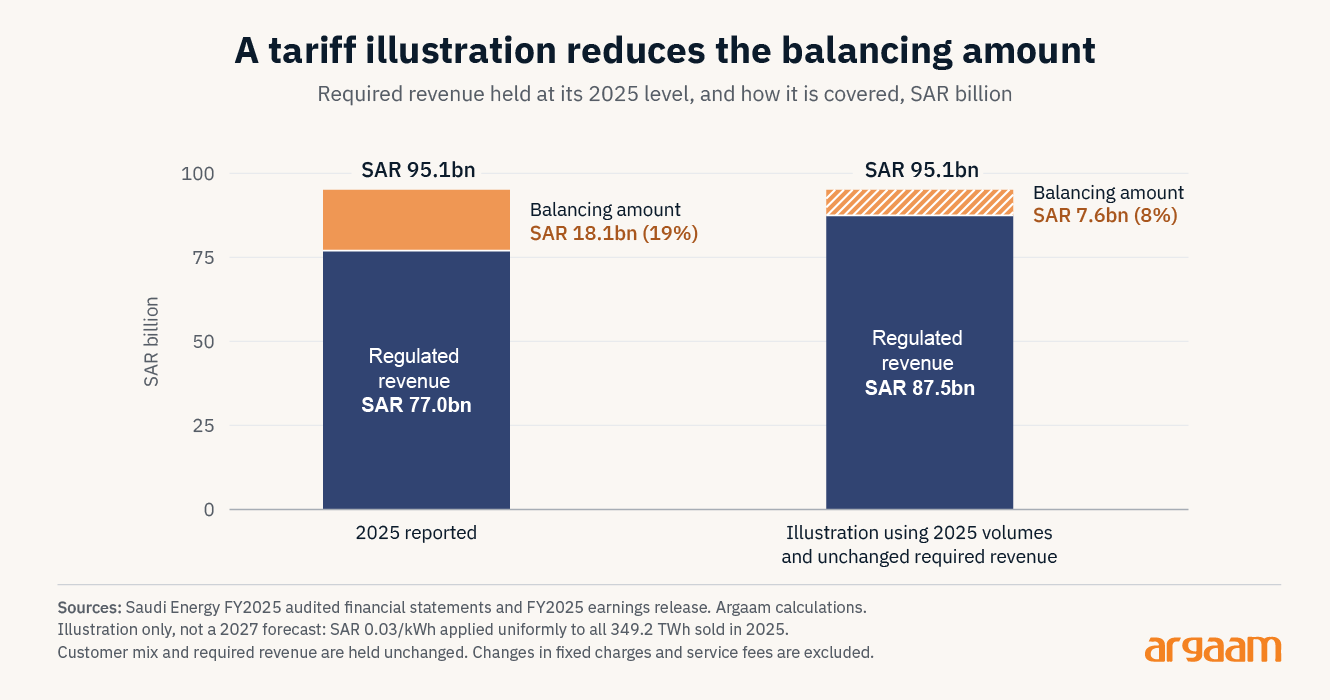
In 2025, the regulator set that figure at SAR95.1 billion. Customers’ bills covered SAR77.0 billion of it. The state made up the remaining SAR18.1 billion, nearly a fifth of the total.
The top-up is large. In 2025 it was nearly as big as Saudi Energy’s operating profit of SAR19.1 billion, and larger than its net profit of SAR13 billion.
That is how the system is designed. The regulator’s figure includes the return the company is allowed to earn, and the top-up is how that return is delivered when customers’ bills fall short.
That is why the tariff rise leaves Saudi Energy’s results unchanged. Customers will pay more and the state will pay less, but the company still receives the same total.
The arrangement also works in reverse. If customers’ bills ever brought in more than the regulator’s figure, Saudi Energy would hand the surplus back. Higher tariffs can never lift its revenue above that figure.
How much the state will save has not been published, but a rough sum gives a sense of scale.
Add three halalas to each of the 349.2 TWh Saudi Energy sold in 2025, and bills rise by about SAR10.5 billion.
That would cut the state's top-up to about SAR7.6 billion, or 8% of required revenue. Customers would still not cover the full amount, so the state would keep paying.
We treat the figure as a rough guide, not a forecast. It assumes Saudi Energy sells as much power, and is allowed as much revenue, as it was in 2025.
It adds three halalas to every unit, though farms pay only one more, so it slightly overstates the rise. And it leaves out the new fixed monthly charges that replace the service fee.
Why Marafiq keeps the gain
Marafiq, which supplies power and water to the industrial cities of Jubail and Yanbu, charges the same regulated electricity tariff as Saudi Energy. Two things set it apart.
First, no one tops up Marafiq’s revenue. It is not part of the balancing account, so when customers’ bills fall short, it bears the gap itself.
Marafiq wants to join the arrangement. In its accounts for the first half of 2026, it said it was still asking to be included and had not yet been admitted.
Second, electricity sold at the regulated tariff is a smaller part of its business: less than 30% of its sales in 2024 and 2025.
The rest came from water, which has its own tariff, from gas, and from contract sales, meaning power and water sold to some customers at prices fixed in long-term contracts rather than at the regulated tariff.
For Marafiq, then, the SAR278 million is genuinely new revenue. It does not replace a state payment, because there was none.
That would change if Marafiq joined the balancing account, which it has been asking to do since at least 2024. Joining would protect it.
Whenever customers’ bills fell short of what its power business needs to earn, the state would make up the difference.
But joining would also cost it something. Like Saudi Energy, Marafiq would gain much less from tariff rises, because higher bills would mostly mean smaller payments from the state.
Without that cushion, Marafiq has had to absorb costs that Saudi Energy passes to the state.
The discount Marafiq absorbed
The clearest example is a discount for energy-intensive plants, which is meant to keep industries for which power is a large share of costs competitive.
It cut their electricity rate from 18 to 12 halalas per kWh, and it applied backwards, to January 2023, the start date the government had set, because qualifying plants were approved only later.
At first, Marafiq said, the mechanism to compensate it for the lower revenue was not yet in place. Until it was, Marafiq could not be sure of collecting part of what it had already billed those plants.
To prepare for that loss, it put aside SAR496.2 million in its 2024 accounts. Largely as a result, its net profit fell from SAR587 million in 2023 to SAR17 million.
The discount formally took effect in May 2025. Marafiq then cancelled SAR475.5 million of power revenue it had already recorded and released the SAR496.2 million it had set aside. The two largely offset each other, leaving a small net gain of SAR20.7 million.
Since then, the cost of the discount has been spread among other customers. From 28 May 2025, industrial, commercial and farm customers who don’t get the discount have paid two halalas more per kWh, at both utilities.
Any shortfall that remains is covered differently at each company. At Saudi Energy, it falls to the state-backed balancing account.
At Marafiq, under a mechanism the regulator set on 13 May 2025, other electricity providers are to make it up, as the regulator directs.
While the cost of the discount has been shared out, fuel has added a new one. Fuel prices rose in January 2026, and Marafiq put the impact at 5.6% of its cost of sales, which we estimate at about SAR300 million a year.
The company made a net loss of SAR46.5 million in the second quarter. It returned to profit in the third, earning SAR154 million, though that was still 10% less than a year earlier.
On our reading, not the company’s, the SAR278 million from the new tariffs roughly offsets that higher fuel bill.
A modest bill, so far
For the industrial companies that pay the new rate, the cost looks modest so far. Most companies that have given figures expect the rise to add between 0.3% and 1.2% to their costs or revenue.
Part of the reason is that the rise is smaller than it can look. The industrial rate goes up 15%, from 20 to 23 halalas per kWh.
Compared with the 18 halalas industry paid before May 2025, it would look like a 28% rise. But two of those five halalas were added in May 2025, when the rate went from 18 to 20, and companies have been paying them since.
Watani Iron Steel’s figures show how the arithmetic works. It expects its cost of sales to rise 1.12%. If its power bill rises by the full 15%, power must make up about 7.5% of its cost of sales.
Some companies, such as Yanbu Cement, said the new rates won’t affect them at all.
They produce their own electricity in their own plants instead of buying it from the grid, so the tariff doesn’t apply to them. They are still exposed to fuel prices, because they burn fuel to make that power.
The same tariff rise lands differently in three places. At Saudi Energy, customers will pay more and the state less, while the company’s own income stays the same.
At Marafiq, the rise is new revenue, roughly enough to cover this year’s higher fuel costs. For the industrial companies that pay it, the cost looks modest so far.
Four things will show whether that holds. Marafiq’s results for the first quarter of 2027, the first to include the new rates, will show how much of the SAR278 million comes through.
Saudi Energy’s 2027 accounts will show how much smaller the state’s top-up has become. A decision to admit Marafiq to the balancing account would change its position.
And any estimates from the heaviest industrial users will show whether the cost to industry stays small.
Editorial Note
We publish without bylines. Our research is produced collectively — analysts, editors and data specialists working on the same questions — and the findings reflect the judgement of the team rather than of any individual.
This is a deliberate choice. It keeps the argument, rather than its author, as the thing a reader weighs.
Every figure here was computed by Argaam analysts from the sources cited, and is reproducible from them. The analysis and conclusions are the team's own. Charts were rendered with AI assistance. Methodology and workbook available to subscribers; questions to intelligence@argaam.com.
Comments {{getCommentCount()}}
Be the first to comment
رد{{comment.DisplayName}} على {{getCommenterName(comment.ParentThreadID)}}
{{comment.DisplayName}}

{{comment.ElapsedTime}}


Comments Analysis: